Southern Cross Blue Cruising | the First Gulet Charter Blog

Mar/10

31

What, exactly, is a gulet?

(This article was originally written by Tony Marciniec and with his permission, I have edited it and focused it to a more casual audience. Comments are greatly appreciated.)

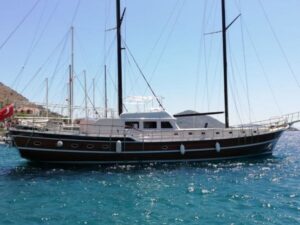
Gulet: a ‘gulet’ is a two-masted, ketch- or schooner-rigged steel or wooden yacht with widely varying sail plans, but characterized by a wide, rounded stern

In the gulet charter industry, we use the term ‘gulet’ with such carefree abandon that we are taken aback when someone asks: What, exactly, is a ‘gulet’? An answer may leap to our lips of ‘Well, it’s a traditional wooden sailing vessel indigenous to the Aegean Sea,’  since it seems to be obvious at first. But when we try to formulate the definition of a gulet with a degree of precision we run into a fog bank of confusion created by sources with differing definitions, inadequate descriptions and careless usage. However, since it is the voyage that is more interesting than the arrival, here’s what some of our research has uncovered so far.

Gemici Dili

The oldest Turkish use of the term ‘gulet’ in professional literature that we found is in “Gemici Dili”, a dictionary of nautical terms compiled by Lütfi Gürçay and published by the Turkish Navy in 1943. In this book the definition (translated) reads: “Gulet – Two-masted schooner smaller than a brig, resembling a pıraçıla (Venetian brazzera-Ed.), lightly rigged, with square sails on the fore mainmast.

Model of a Brazzera

Model of a Brazzera

Kaptanin Kilavuzu

Another authoritative definition of a ‘gulet’ is given in “Kaptanın Kılavuzu” (by Capt. Yücel Sügen, publ. 1998), translated it goes like this: “A two-masted, lightly rigged sailing vessel, smaller than a brig, with a fully rigged foremast with square sails and the mainmast with gaff-rigged mainsail.

Fisherman of Halikarnas

The oldest use of the term in popular literature appears to be in the 1946 edition of ‘Aganta Burina Burinata’, a book by Cevat Sakir Kabaagacli, better known by his penname of ‘The Fisherman of Halicarnassus’. But even this author clouds the issue by giving two different spellings on different pages: ‘gulet’ and ‘golet’.

Goelettes, goulettes and Koleytes

The precise origins of the use of the word ‘gulet’ in present-day Turkish are unclear, although French references to ‘goulettes’ can be found in the 18th century. In Turkish, the word does not appear to have been widely used until the latter part of the 20th century when publicity for large-scale tourism demanded that charter operators be a bit more specific than just saying ‘boat for hire’. It should be noted, as a matter of interest, that the author of a 1945 history of Bodrum, Avram Galanti Bodrumlu, does use ‘goelette’ as an equivalent for ‘ koleyte’, a vessel reportedly used in the 16th century by the famed corsair and Ottoman admiral, Turgutreis.

Admiral Turgutreis

Admiral Turgutreis

His ‘koleyte’ is a transliteration of a term written in Arabic script used by the historian Müneccimbaşı., but so far we have been unable to determine what it meant. Since Avram Galanti Bodrumlu was fluent in French we may assume that he tried to make an archaic Ottoman name more understandable to readers of the Turkish Republic, but although he was an accomplished linguist, historian and parliamentarian we cannot be sure of the depth of his knowledge of ships or nautical nomenclature.

Galiota

It seems possible that the Turkish adoption of the word ‘gulet’ came from the Venetian ‘galiota’. A heavy infiltration of nautical terms from Greek and Italian languages into Turkish is suggested in the Lingua Franca in the Levant: Turkish Nautical Terms of Greek and Italian Origin, which provides a very complete etymology of the term ‘galiota’ and suggests that this may be a ‘galleon of freighter shape.’ It also finds reference to a ‘warship with 19 to 24 rowing banks’ and that ‘galiota’ may be a diminutive of ‘galea’, a word dating back to the 12th century as a description of various types of ships until the 18th century. Keeping in mind the rough-and-ready brotherhood of the sea, and its ingrained tendency to have an exclusive jargon understood only by the initiate, the above-mentioned Müneccimbaşı’s ‘koleyte’ does seem to contain a faint echo of ‘galiota’ – perhaps as they would be spoken with differing local accents in sailors’ watering-holes in ages gone by.

Artist impression of a Galiota

Artist impression of a Galiota

Kos or Italy? The Bonds of World War II

But without going as far back as the ages of Venetian maritime superiority and influence, there are more recent opportunities for Italian terms to be adopted by Turkish sailors of the Aegean. In 1912 the Italians occupied the Dodecanese islands, making them next door neighbors of mainland Turkey. There are some Bodrum natives still alive who remember those years with a touch of nostalgia: a recently deceased ancient mariner related how he saw his first automobile ‘in Italy’, explaining – when questioned – that by Italy he meant the island of Kos!

Between 1912 and 1946 intercourse between the inhabitants on Turkish coast and those of the Dodecanese islands was intensive, with trade and personal bonds between them exceeding by far their relationships with their respective national homelands. It seems reasonable to suppose therefore that many Italian terms sneaked into local usage without drawing thunder from linguistic purists.

This local Turco-Italian intercourse was probably reinforced after the Ottoman Empire’s losses of World War I, when Bodrum itself was occupied briefly by Italian military forces. Relations between the Italian soldiers and Bodrum residents are known to have been peaceful and it can be assumed that local people were exposed daily to some variants of the Italian vocabulary. However, we have been unable to find any conclusive evidence that the Turkish use of ‘gulet’ stems from these years.

Old Dictionaries and Gulets

The magic of the Internet has now allowed us to query online resources, and it seems clear from two of them, Dizionario dei termini nautici and the English-French Sailing Dictionary, that ‘gulet’ not being a native Turkish term, must be derived from the Italian ‘goletta’ or the French ‘goelette’, both meaning ‘schooner’ in English.

Later, the term ‘gulet’, (variants include gulette, goulette, and guletta) also began to include other Turkish wooden boats of similar design.  However, in contemporary usage amongst the Turkish charter sailing community a ‘gulet’ is a two-masted, ketch- or schooner-rigged steel or wooden yacht with widely varying sail plans, but characterized by a wide, rounded stern. Sometimes, one may find ‘gulet’ written as ‘gullet’, in which case we are tempted to suppose that the author had provisions rather than boats on his mind.

Ketch or Ayna kic?

One of the most annoying trends in the gulet industry has been the gradual use of the word ‘ketch’ to describe what is in fact an ‘ayna kic which means ‘flat or mirror back.’  Gulets can be round stern (gulet), flat stern (ayna kic) or double ender (tirhandil). Because ‘ketch’ and ‘kic’ sound similar to one another, both native Turks and foreigners have carelessly used the word ‘ketch’ to describe a transom stern (flat back) gulet.  In fact, a ketch is a rigging and completely independent of the type of gulet.  . All of these yachts can be rigged either as schooner, ketch, gaffe or a combination thereof.  It is important to our industry to correct and retain the right terminology for our product.

Rounded stern (gulet)

Rounded stern (gulet)

Transom stern gulet (ayna kic) not a ketch!

Transom stern gulet (ayna kic) not a ketch!

To summarize, there isn’t an exact terminology for the definition of what a gulet is or isn’t.  More important than the exact definition of a gulet is to correct the mis-use of ‘ketch’, lest our industry appear less than fully professional to real sailors.

RSS Feed

No comments yet.

Leave a comment!

<< Turkey:Why is a bird named after a Eurasian country?

Model Miniature Wooden Gulets >>

Find it!

Theme Design by devolux.org